
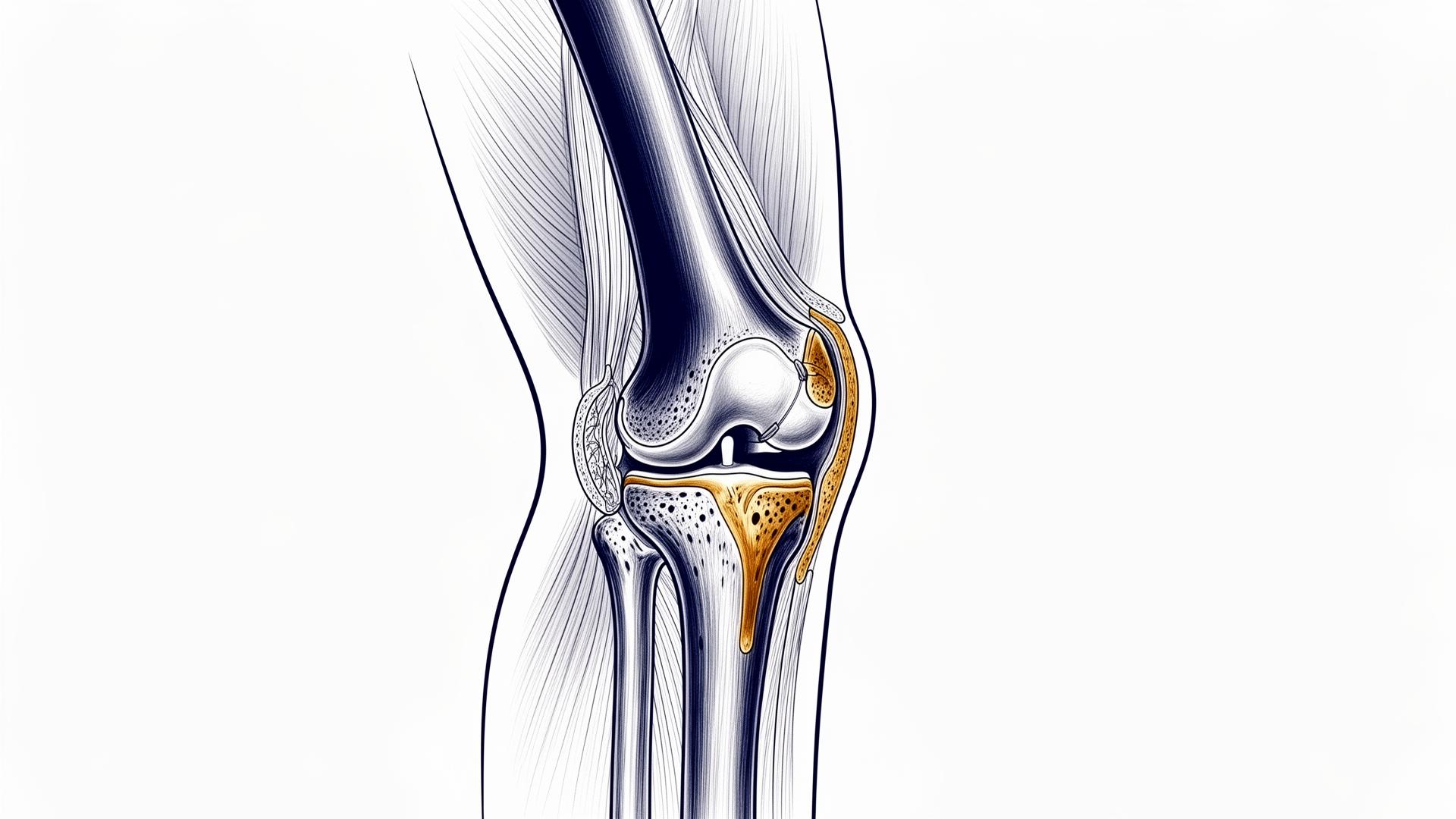
Computer-assisted joint replacement (navigation)
Computerised navigation systems to control alignment, component orientation and ligament balancing in real time.
Computer-assisted joint replacement — also called navigated surgery — uses an optical tracking system and a dedicated computer to guide the surgeon during knee or hip replacement.
The navigator displays limb alignment, bone-cut orientation and ligament tension in real time, allowing immediate checks and corrections. Surgical gestures are still performed with traditional instruments, under the surgeon's complete control.
It is particularly useful in cases with deformity, complex anatomy, fracture sequelae or retained fixation hardware, where the usual anatomical landmarks are altered.
How computerised navigation works
Optical tracking
Small reflective markers are fixed to the patient's bone and detected by an infrared camera. The computer reconstructs the spatial position of the femur, tibia or pelvis in real time, creating a digital anatomical reference of the limb.
Alignment control
During bone cuts the navigator shows the actual angle relative to the mechanical axis of the limb, allowing immediate correction of any deviation. The goal is accurate, reproducible alignment, with fewer out-of-target implants.
Ligament balancing
In knee replacement the system measures joint spaces in flexion and extension and ligament tension, helping the surgeon achieve symmetric balancing: a key factor for prosthesis stability and kinematics.
Final verification
Once the implant is positioned, the navigator documents the achieved alignment and range of motion, providing objective confirmation of the result before closure.
When navigation makes the difference
Cases where it is particularly indicated
- Significant axial deformities: severe varus or valgus knee
- Complex anatomy or anatomy altered by previous surgery
- Fracture sequelae with residual malalignment
- Retained fixation hardware (plates, screws, nails) that prevents the use of traditional guides
- Medullary canal stenosis or alterations that make intramedullary landmarks unreliable
In standard cases
Without deformity or anatomical alterations, navigation remains a useful verification tool, but the results of the traditional technique in experienced hands are comparable. The choice of technology is always shared with the patient after clinical assessment.
Robot, navigator or traditional technique?
| Aspect | Traditional | Navigated | Robotic |
|---|---|---|---|
| Intraoperative information | Anatomical landmarks and the surgeon's experience | Real-time data on alignment and balancing | Real-time data + pre-operative 3D plan |
| Bone cuts | Traditional mechanical guides | Traditional guides verified by the navigator | Robotic arm constrained to the planned cuts |
| Pre-operative planning | 2D X-rays | 2D X-rays | 3D model from CT or X-rays |
| Key strength | Simplicity and consolidated effectiveness | Objective control without changing the surgical gesture | Maximum execution accuracy |
Learn more about robotic joint replacement.
Frequently asked questions about computer-assisted surgery
What is computer navigation in joint replacement?
It is a system that, through optical tracking and a dedicated computer, provides the surgeon with real-time data on limb alignment, component orientation and ligament balancing during surgery. The navigator guides and verifies the surgical gesture, which is still performed with traditional instruments.
Does the computer perform the surgery?
No. The computer processes and displays information, but every gesture — from bone cuts to component placement — is performed directly by the surgeon. Navigation is a verification and precision tool, not an executor.
What is the difference between a navigator and a robot?
The navigator provides real-time information that the surgeon uses to guide traditional instruments. The robot adds a robotic arm that physically assists the execution of cuts according to the pre-operative plan. Both technologies increase precision; the choice depends on the case and the facility.
Is navigation useful in simple cases too?
In standard cases with regular anatomy, the traditional technique in experienced hands guarantees excellent results. Navigation offers its greatest advantage in cases with deformity, complex anatomy, fracture sequelae or retained fixation hardware, where the usual anatomical landmarks are altered.
Does navigation make surgery longer?
Positioning the tracking markers takes only a few extra minutes. In complex cases this time is largely offset by greater execution safety and fewer intraoperative corrections.
Is it covered by the national health service?
It depends on the facility where the surgery is performed and on the access pathway (public health service, insurance agreements or private care). Coverage should be verified during the consultation.
Want to know which technique suits your case?
Traditional, navigated or robotic: the choice comes from an accurate clinical and radiographic assessment. Book a consultation to discuss your case.
Mon–Fri · 4:00–6:00 pm
The information on this page is for educational purposes only and does not replace a specialist consultation or medical advice in any way. Every surgical indication is defined exclusively after a direct clinical assessment of the patient and of the instrumental examinations. Content drafted in compliance with the FNOMCeO Guidelines (Articles 55-56-57 of the Italian Medical Code of Ethics).