
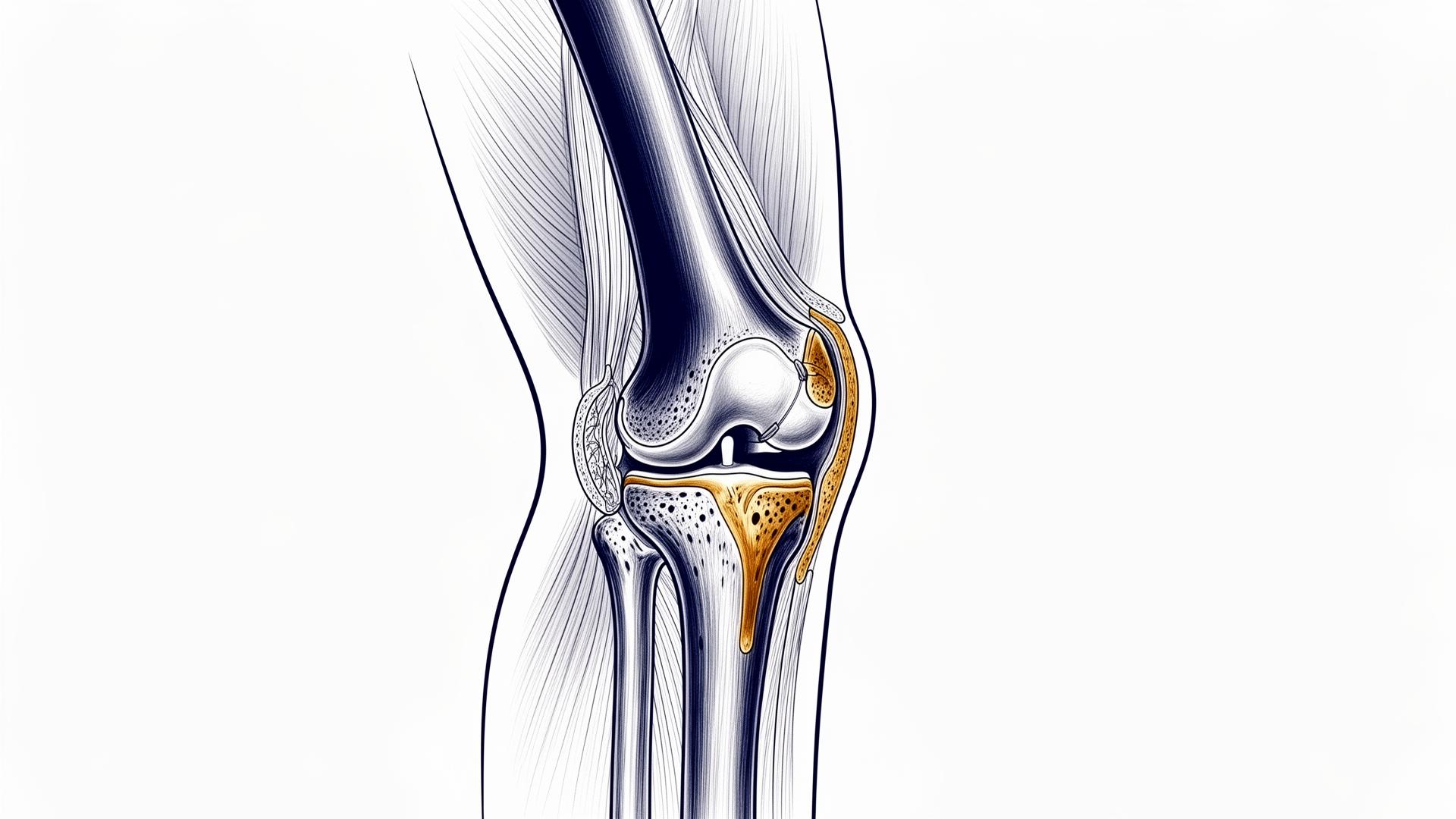
Robotic joint replacement in Rome
Knee and hip replacement with robotic platforms: personalised three-dimensional planning and sub-millimetre accuracy, with the surgeon always in command.
Robotic joint replacement is a technique in which a robotic platform assists the surgeon during knee or hip replacement surgery. The procedure is planned in advance on a three-dimensional model of the patient's joint, built from CT scans or X-rays.
During surgery, a robotic arm guides the bone cuts according to the established plan, with sub-millimetre accuracy. The surgeon always retains full control: the robot does not operate autonomously.
Scientific literature documents more precise component positioning and reduced variability compared to the traditional technique, with possible benefits for functional recovery in the first months.
How robotic surgery works
Three integrated phases: planning, assisted execution, verification.
Pre-operative 3D planning
Before surgery, the patient's images (CT scan or weight-bearing X-rays) are processed to build a three-dimensional model of the joint. On this model the surgeon defines the size, orientation and positioning of the prosthetic components, adapting the plan to the individual anatomy.
The robotic arm in the operating room
In the operating room the robotic platform registers the patient's actual anatomy and matches it with the pre-operative plan. The robotic arm assists the surgeon in performing the bone cuts, constraining the instrument within the planned boundaries and protecting the surrounding soft tissues.
The surgeon stays in control
The robot performs no gesture autonomously. Every phase — from joint exposure to definitive component placement — is carried out and verified by the surgeon, who can modify the plan at any time based on intraoperative conditions.
Which prostheses it is used for
Total knee replacement
Robotic planning optimises alignment, rotation and ligament balancing of the total knee replacement — parameters that are decisive for the kinematics and longevity of the implant.
Unicompartmental knee replacement
This is the application where robotic precision has shown the most consistent benefits: replacing a single compartment requires very tight tolerances to preserve healthy cartilage and ligaments.
Total hip replacement
In the hip as in the knee, 3D planning helps control leg length, offset and cup orientation, reducing the risk of limb-length discrepancy and instability.
Learn more about the individual procedures: knee surgery and hip surgery.
Benefits documented in the literature
A cautious tone is appropriate: robotics increases precision, but the outcome always depends on the correct indication and the surgeon's experience.
What studies demonstrate
- Greater accuracy and reproducibility in component positioning compared to the traditional technique
- Fewer implants with out-of-target alignment (outliers)
- Planning personalised to the individual patient's anatomy
- Possible reduction in pain and faster functional recovery in the first post-operative months
What studies do not (yet) demonstrate
There is currently no definitive evidence that robotic surgery extends long-term prosthesis survival compared to a well-performed traditional technique. The choice of technology should therefore be assessed honestly, case by case.
Who it is suitable for — and who it is not
When robotics offers a concrete advantage
- Young, active patients, where positioning accuracy is a priority
- Significant axial deformities (severe varus or valgus)
- Complex anatomy or sequelae of fractures and previous surgery
- Unicompartmental replacements, where tolerances are very tight
- Selected revision cases, after specialist assessment
When it is not necessary
In standard cases with regular anatomy, a traditional or navigated technique in experienced hands guarantees excellent results. Technology is a tool serving the indication, not an end in itself: the choice is shared with the patient after clinical and radiographic assessment.
Traditional, navigated or robotic?
| Aspect | Traditional | Navigated | Robotic |
|---|---|---|---|
| Planning | 2D X-rays and standard measurements | 2D X-rays + computerised intraoperative control | Personalised 3D model from CT or X-rays |
| Bone cuts | Mechanical instruments guided by the surgeon's experience | Traditional instruments with real-time navigator verification | Robotic arm assisting the surgeon within planned boundaries |
| Alignment accuracy | Experience-dependent; excellent in expert hands | Reduced variability, fewer outliers | Maximum accuracy, sub-millimetre |
| Surgeon's control | Total | Total | Total: the robot assists, it does not decide |
| Typical indications | Standard cases, regular anatomy | Deformity, complex anatomy, post-traumatic sequelae | Young patients, partial replacements, complex cases |
Learn more about computer-assisted (navigated) joint replacement.
Recovery after robotic replacement
What to expect
- Standing and first steps with crutches from the day after surgery
- Discharge generally within 2-4 days, depending on the procedure and general condition
- Return to daily activities in 6-8 weeks
- Full functional recovery between the third and sixth month, with dedicated physiotherapy
The role of rehabilitation
Implant precision does not replace rehabilitation: a structured physiotherapy pathway remains decisive for the final outcome, regardless of the technology used.
Frequently asked questions about robotic surgery
Does the robot operate on its own?
No. The robot is a precision tool guided by the surgeon at every stage of the procedure. Planning, joint exposure, bone cuts and component placement remain under the surgeon's direct control: the robotic platform assists the surgical gesture, it does not replace it.
Does a robotically implanted prosthesis last longer?
Scientific literature documents greater accuracy in component positioning and fewer out-of-target alignments. More precise positioning is considered a favourable factor for implant longevity, but long-term survival depends on many variables: age, weight, physical activity, bone quality and rehabilitation.
Is robotic surgery more painful or riskier?
No. Surgical times are comparable to the traditional technique and the safety profile is equivalent. Some studies report less post-operative pain and faster functional recovery in the first months, probably due to greater preservation of soft tissues.
Which procedures can use the robot?
Robotic platforms are currently used for total knee replacement, unicompartmental (partial) knee replacement and total hip replacement. The indication is assessed case by case based on anatomy, deformity and patient characteristics.
Is it covered by the national health service?
It depends on the facility where the surgery is performed and on the access pathway (public health service, insurance agreements or private care). Coverage should be verified during the consultation.
Is a CT scan needed before surgery?
Some robotic platforms require a pre-operative CT scan to build a three-dimensional model of the joint; others work from X-rays or intraoperative acquisition. The choice depends on the system used and the type of procedure.
What is the difference between robotic and navigated surgery?
Computer navigation gives the surgeon real-time information on alignment and balancing, but bone cuts are performed with traditional instruments. Robotic surgery adds a robotic arm that physically assists the execution of cuts according to the pre-operative plan. Both increase precision compared to the traditional technique.
Want to know if robotic surgery is right for you?
The choice between traditional, navigated and robotic techniques comes from an accurate clinical and radiographic assessment. Book a consultation to discuss your case.
Mon–Fri · 4:00–6:00 pm
The information on this page is for educational purposes only and does not replace a specialist consultation or medical advice in any way. Every surgical indication is defined exclusively after a direct clinical assessment of the patient and of the instrumental examinations. Content drafted in compliance with the FNOMCeO Guidelines (Articles 55-56-57 of the Italian Medical Code of Ethics).