
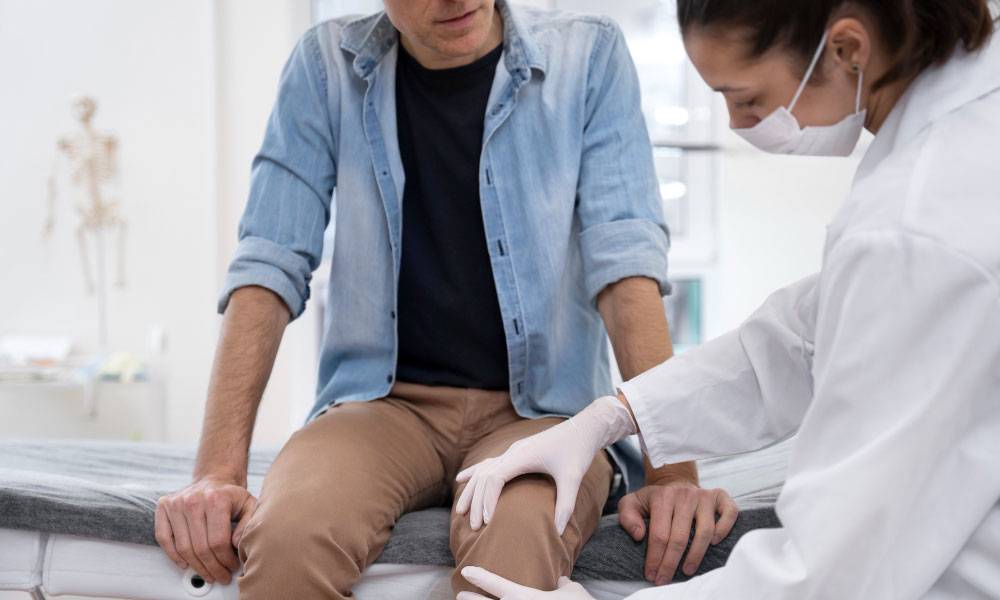
Knee arthroscopy is a minimally invasive surgical procedure that allows several pathologies of the knee joint to be diagnosed and treated. This procedure has gained popularity in recent decades thanks to the possibility of treating a growing number of pathologies and to the ability to respect the joint, ensuring faster recovery and reduced post-operative pain compared to open surgery.
What is knee arthroscopy?
Arthroscopy is a surgical technique that uses an arthroscope, an instrument equipped with a small camera, to visualise the inside of the joint. Through small incisions the surgeon can explore the knee, diagnose pathological conditions and treat a wide range of them, such as ligament reconstruction, removal of loose bodies, partial resection or suture of the menisci, or cartilage repair.
When is arthroscopy necessary?
Knee arthroscopy is often indicated for patients presenting with persistent symptoms such as pain, swelling or joint stiffness. The most common conditions that may require this operation include meniscal tears, cruciate ligament injuries, chondral lesions and the presence of loose bodies.
The diagnosis is made after careful history taking, clinical evaluation and is confirmed with imaging tests such as MRI.
How is the operation performed?
Knee arthroscopy is usually performed under loco-regional anaesthesia. During the procedure the surgeon makes small incisions in the knee joint and inserts the arthroscope to obtain a detailed view. Depending on the pathology, the surgeon can then proceed with the necessary repairs, reconstructions or resections.
The duration of the operation varies but usually takes less than an hour. One of the main advantages of arthroscopy is that, thanks to the small incisions, the risk of complications and post-operative pain are significantly lower than with open surgery.
Recovery and rehabilitation: return to normality
Recovery after knee arthroscopy is generally rapid. Many patients can go home the same day as the operation. In the first days it is essential to follow the physician's instructions regarding rest, ice and pain management.
Physiotherapy is an important component of recovery. Rehabilitation exercises help restore joint mobility, strength and function. Most patients can return to normal daily activities within a few weeks, but recovery time may vary depending on the type of pathology treated.
Risks and complications: what to consider
Although knee arthroscopy is considered a safe procedure, it carries some — albeit rare — risks such as infections, nerve or vascular injuries and internal adhesions. It is essential that patients discuss these risks with their surgeon before the operation.
An innovative approach to knee recovery
Knee arthroscopy is an effective solution for a range of joint problems. Thanks to its minimally invasive nature, it offers faster recovery and fewer complications than traditional techniques. A correct diagnosis and an appropriate rehabilitation plan are essential to guarantee optimal results.