
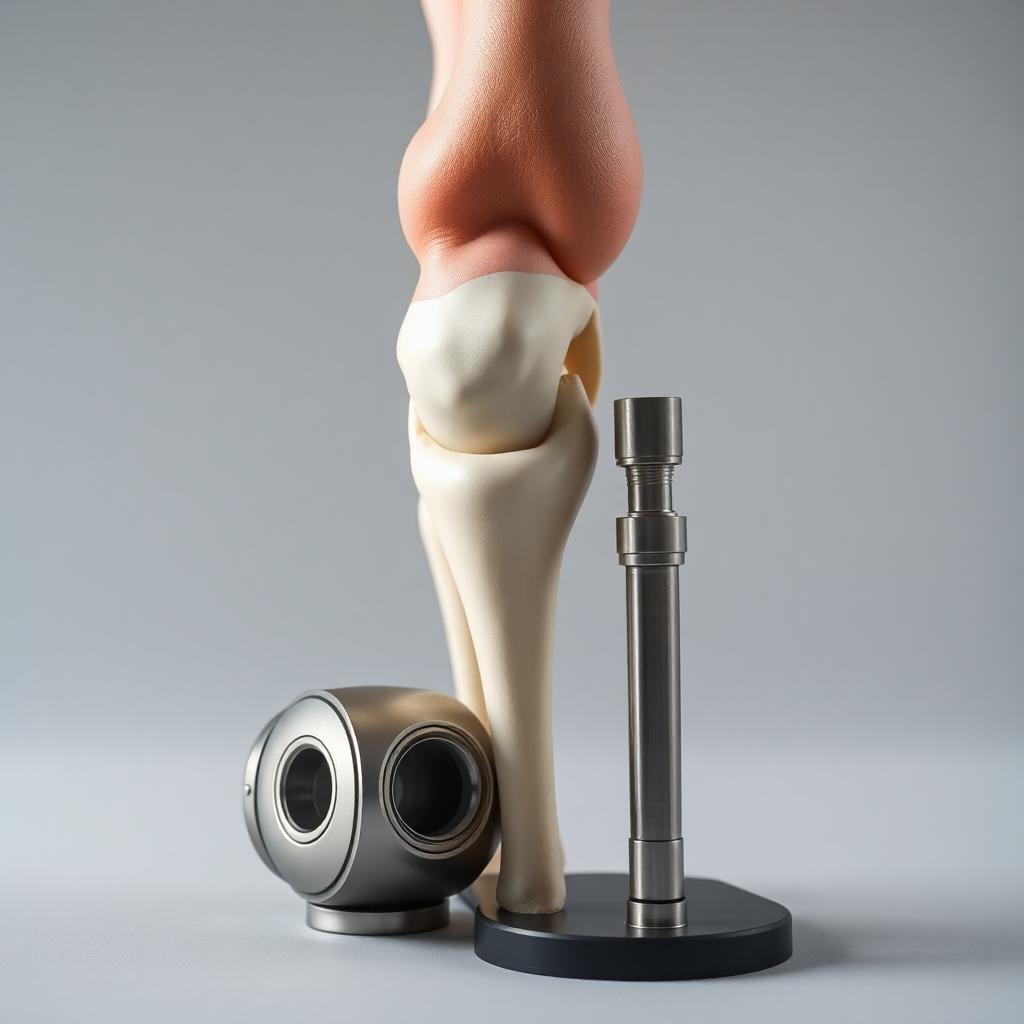
The knee is the joint that bears the weight of the entire body at every step. When the cartilage lining the articular surfaces wears down — through progressive use or the after-effects of old injuries — osteoarthritis sets in. The femur and tibia, no longer protected by cartilage, begin to rub directly against each other. The result is pain that first appears under exertion, then at rest and at night, together with joint effusion and stiffness. Everyday activities become difficult: climbing or descending stairs is an obstacle, getting up from a chair requires considerable effort, and walking more than a few hundred metres is no longer natural. Advanced knee osteoarthritis is not only a physical issue: it progressively narrows the living space of the people affected.
Knee replacement is the orthopaedic operation that interrupts this progression. The surgeon removes the worn articular surfaces and replaces them with artificial components in metal and plastic (polyethylene), designed to reproduce the natural movement of the joint as faithfully as possible and to restore a correct loading axis. For many patients this is the moment they stop limiting their life because of pain.
When knee replacement is indicated
The main indication is advanced knee osteoarthritis (gonarthrosis), a condition in which the articular cartilage wears down progressively until it disappears, generating chronic pain, morning stiffness and functional limitation in simple daily activities such as walking, climbing stairs and standing up from a chair. Surgery is considered when conservative treatments (medication, physiotherapy, injections) no longer control the symptoms satisfactorily.
Who benefits most from knee replacement
Not every patient with gonarthrosis reaches the same surgical conclusion. There are profiles for which knee replacement produces particularly significant results.
Patients with marked varus or valgus deformity
When the axis of the limb is visibly altered — the classic "bow-legged" or "knock-kneed" appearance — the prosthesis not only eliminates pain but also corrects the mechanical alignment of the limb, with benefits along the whole postural chain up to the hip and back.
Patients with disabling night pain
Pain that does not subside even at rest or during sleep is one of the clearest signs that joint structures are compromised beyond the threshold of compensation. In these cases the prosthesis offers relief that no conservative treatment can provide.
Active patients limited by osteoarthritis
Those who led a physically active life before the onset of osteoarthritis, practising recreational sports, and who are forced to drastically reduce these activities, obtain functional recovery from the prosthesis that is often above expectations.
Patients with documented tricompartmental gonarthrosis
When weight-bearing X-rays show a reduction or disappearance of the joint space in all three compartments of the knee, total replacement is the most effective and durable solution compared to any conservative or partial approach.
Who should wait or consider alternatives
There are also cases in which surgery may not be conclusive. These are generally patients with a very high body mass index, unstable cardiovascular disease or unrealistic expectations about the post-operative result: they require deeper evaluation before proceeding. In such cases the orthopaedic surgeon may recommend a preparation programme — weight loss, optimisation of medical therapy — to improve the outcome.
Total or partial prosthesis: what is the difference
Total knee replacement resurfaces all three compartments of the knee (medial and lateral femoro-tibial and patello-femoral). It is the most common choice in cases of diffuse gonarthrosis and limb malalignment.
Partial (unicompartmental) prosthesis addresses only one compartment of the joint — usually the medial one — and is indicated when the damage is localised. It involves a smaller incision and generally a faster recovery.
How the decision is made: the diagnostic pathway
The surgical decision is based on three combined elements: the patient's clinical history, the physical examination of the joint and imaging studies. Weight-bearing X-rays are essential to assess joint-space narrowing and any varus or valgus deformity. MRI is requested in selected cases to analyse soft tissues. The orthopaedic surgeon compares these data with the patient's symptoms: persistent pain, locking, instability, stiffness.
How the operation is performed
Knee replacement is performed under spinal or epidural anaesthesia: the patient is awake but numb from the abdomen down, with a better anaesthetic safety profile than general anaesthesia, especially in elderly patients or those with cardiovascular comorbidities. The overall duration of the operation is around one hour.
The surgeon accesses the joint through an anterior incision on the knee, exposes the worn articular surfaces and removes them using calibrated cutting guides that follow the mechanical axis of the limb. Precision at this stage is decisive: an inaccuracy of just a few degrees in component alignment compromises load distribution, reduces joint stability and accelerates wear of the prosthesis.
The prosthetic components (femoral, tibial and, when indicated, patellar) are fixed to the bone with acrylic cement or with a press-fit technique that exploits biological bone growth around the porous surface of the implant. The choice between the two techniques depends on bone quality and surgeon preference.
The operation ends with restoration of correct limb alignment and intra-operative verification of ligament stability and range of motion.
Recovery: realistic timing
The post-operative hospital stay averages 2-3 days. Physiotherapy starts the same day or the day after surgery: early mobilisation reduces the risk of deep-vein thrombosis and accelerates functional recovery.
The fast-track protocol, now the standard in advanced orthopaedic centres, optimises perioperative pain management and shortens the hospital stay without increasing complications.
In the first weeks at home the patient works on regaining movement (flexion-extension) and strengthening the quadriceps. Independent walking without aids is usually achieved within 4-6 weeks. Full functional recovery takes 3-6 months.
Risks and complications to be aware of
Every surgical operation carries risks. For knee replacement the most relevant are: periprosthetic infection, rare but serious, which may require revision surgery; deep-vein thrombosis, prevented with anticoagulant therapy and early mobilisation; joint stiffness, reduced with intensive physiotherapy in the first weeks; aseptic loosening of the prosthesis, a late complication that may require revision.
Strict adherence to the rehabilitation programme and follow-up controls significantly reduces the incidence of these complications.
What changes after the operation
Most patients report a clear reduction in chronic pain and recovery of daily activities within the first months. Low-impact sports such as swimming, cycling and walking are compatible with the prosthesis. High-impact activities such as strenuous running are generally discouraged to preserve the durability of the implant.
Latest-generation knee prostheses have an average lifespan of more than 15-20 years. Realistic expectations about timing and type of recovery are an integral part of the success of the operation.
Frequently asked questions on knee replacement
At what age can knee replacement be performed?
There is no minimum or maximum age for knee replacement. Patients between 60 and 75 years old represent the most frequent age range for this operation, but procedures under 55 are increasing thanks to the greater durability of new-generation prostheses and to the higher functional demand of younger patients.
How long does a knee prosthesis last?
Latest-generation knee prostheses have an average lifespan of more than 15-20 years. Longevity depends on several factors: body weight, level of physical activity, bone quality and surgical technique.
Is knee replacement covered by the Italian National Health Service?
Yes. Knee replacement is covered by the Italian NHS as ordinary in-patient care when the clinical indications are documented.
How long do patients stay in bed after knee replacement?
Bed rest is reduced to a minimum. With today's fast-track protocols, the patient stands up and starts walking with the physiotherapist within the first 24 hours after surgery. Early mobilisation is an integral part of the treatment protocol: it reduces the risk of deep-vein thrombosis and accelerates functional recovery.
When can patients walk normally again?
Independent walking without aids (crutches or walker) is generally possible within 4-6 weeks of surgery. Full functional recovery, with a regular gait, ability to climb stairs and carry out daily activities without significant limitations, takes between 3 and 6 months depending on rehabilitation commitment and general health.
Can knee replacement be performed on both legs?
Yes. In patients with severe bilateral gonarthrosis both knees can be operated on. The approach can be simultaneous, both prostheses in the same operation, or sequential, with a few months between operations.
Total or partial prosthesis: how is the choice made?
Partial (unicompartmental) prosthesis is indicated when arthritis is localised to a single compartment of the knee — usually the medial one — limb alignment is close to normal and the cruciate ligaments are intact. It offers advantages in terms of bone preservation and a faster, more physiological recovery. Total prosthesis is the standard choice in cases of diffuse arthritis in multiple compartments. The decision is made by the orthopaedic surgeon based on weight-bearing X-rays and clinical examination.
Which sports can be practised after the prosthesis?
After full recovery, low-impact sports such as swimming, cycling, Nordic walking and golf are generally compatible with the knee prosthesis. High-impact activities such as running, alpine skiing and contact sports must be evaluated individually because they can accelerate wear of the prosthetic components and reduce the lifespan of the implant.